


New 04 Jun 2026
Custom Ecommerce App Development vs Ready-Made Solutions: Which Is Better for Your Business?

Writen by Admin
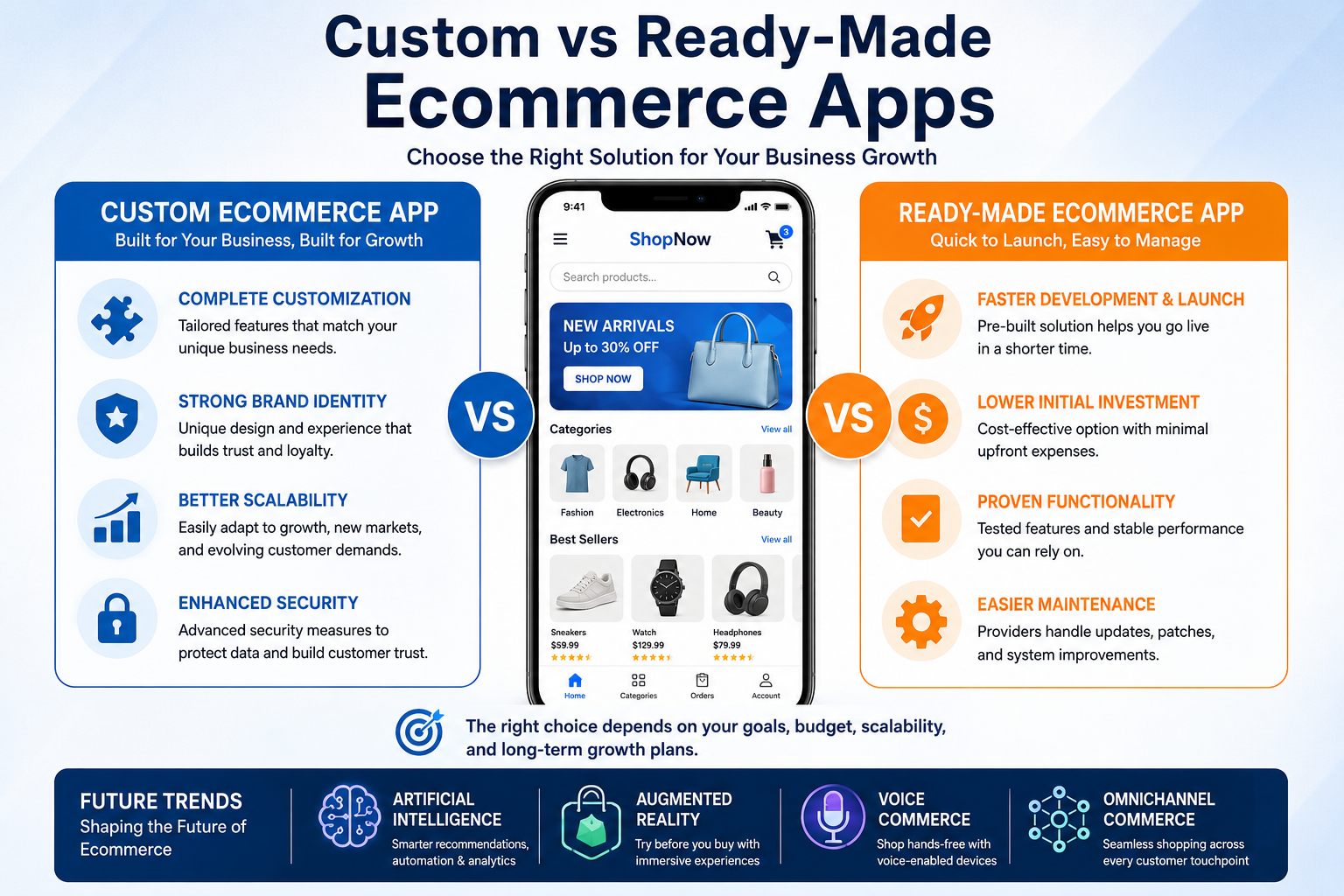
As mobile commerce continues to dominate the online shopping landscape, businesses are increasingly investing in ecommerce applications to engage customers and drive sales. However, one important decision often arises before development begins: should you choose a custom ecommerce app or a ready-made solution?
Both options have advantages and disadvantages, and the right choice depends on your business goals, budget, scalability requirements, and long-term growth plans. While ready-made platforms offer faster deployment and lower upfront costs, custom solutions provide greater flexibility, enhanced branding, and superior customer experiences.
A professional ecommerce app development company can help businesses evaluate their needs and choose the most effective solution. This article explores the key differences between custom ecommerce app development and ready-made ecommerce applications to help you make an informed decision.
Understanding Ecommerce App Development Options
Before comparing the two approaches, it's important to understand what each option involves.
What Is a Custom Ecommerce App?
A custom ecommerce application is built specifically for your business from the ground up.
The app is designed according to your:
- Business model
- Customer requirements
- Branding guidelines
- Operational processes
- Growth objectives
Every feature is tailored to your specific needs, allowing maximum flexibility and control.
What Is a Ready-Made Ecommerce App?
A ready-made ecommerce application is a pre-built solution that businesses can customize to some extent.
These platforms typically include:
- Product management
- Shopping carts
- Payment gateways
- Order management
- Customer accounts
Ready-made solutions are often quicker to launch but may have limitations regarding customization and scalability.
Benefits of Custom Ecommerce App Development
Complete Customization
One of the biggest advantages of custom development is flexibility.
An experienced ecommerce app development company can create features that align perfectly with your business requirements.
Examples include:
- Personalized shopping experiences
- Custom checkout flows
- Industry-specific functionality
- Unique loyalty programs
- Advanced analytics dashboards
This level of customization allows businesses to stand out in competitive markets.
Strong Brand Identity
Brand consistency plays a major role in customer trust and recognition.
Custom applications allow businesses to control:
- Design elements
- User interface
- Navigation structure
- Customer journeys
- Visual branding
A unique mobile experience strengthens customer loyalty and improves brand perception.
Better Scalability
As businesses grow, their technology requirements evolve.
Custom ecommerce apps can easily accommodate:
- Larger product catalogs
- Increased traffic
- New features
- International expansion
- Additional integrations
Scalability ensures long-term business success without major platform limitations.
Enhanced Security
Security is a top priority for ecommerce businesses.
Custom-built applications can incorporate advanced security measures such as:
- Multi-factor authentication
- End-to-end encryption
- Secure APIs
- Fraud detection systems
These features help protect sensitive customer information and maintain trust.
Advantages of Ready-Made Ecommerce Solutions
Faster Development and Launch
One of the main benefits of ready-made solutions is speed.
Since much of the infrastructure already exists, businesses can launch applications quickly.
This can be beneficial for:
- Startups
- Small businesses
- New product launches
- Businesses with urgent timelines
Quick deployment enables companies to enter the market faster.
Lower Initial Investment
Ready-made solutions generally require less upfront investment compared to custom development.
Businesses can avoid:
- Extensive design costs
- Custom coding expenses
- Long development cycles
For organizations with limited budgets, this can be an attractive option.
Proven Functionality
Established ecommerce platforms have already been tested by thousands of users.
They typically offer stable features such as:
- Product management
- Inventory tracking
- Checkout systems
- Payment integration
This reduces the risk of development-related issues.
Easier Maintenance
Many ready-made providers handle:
- Updates
- Security patches
- Performance improvements
- Bug fixes
This reduces the technical burden on businesses.
Limitations of Ready-Made Ecommerce Apps
Limited Customization
While ready-made solutions offer some customization options, they often have restrictions.
Businesses may struggle to:
- Create unique customer experiences
- Add specialized features
- Modify core functionality
These limitations can affect competitiveness and innovation.
Scalability Challenges
As businesses grow, ready-made platforms may encounter performance limitations.
Common issues include:
- Restricted integrations
- Slower performance
- Feature limitations
- Additional subscription costs
These challenges can hinder long-term growth.
Recurring Fees
Many ready-made ecommerce platforms operate on subscription models.
Costs may include:
- Monthly licensing fees
- Transaction charges
- Premium feature costs
- Additional user fees
Over time, these expenses can become significant.
Less Control Over Infrastructure
Businesses using ready-made platforms often have limited control over:
- Hosting environments
- Security configurations
- System architecture
- Platform updates
This dependency can create operational challenges.
When Custom Ecommerce App Development Is the Better Choice
A custom solution may be ideal if your business:
Has Unique Requirements
Companies with specialized workflows often need features unavailable in standard platforms.
Examples include:
- B2B ecommerce systems
- Subscription-based models
- Multi-vendor marketplaces
- Industry-specific compliance requirements
Custom development supports these unique needs effectively.
Plans for Rapid Growth
Businesses anticipating significant growth benefit from scalable solutions.
Custom applications can expand alongside:
- Customer demand
- Product offerings
- Geographic expansion
This flexibility supports long-term success.
Wants Competitive Differentiation
Standing out in crowded markets requires innovation.
Custom ecommerce applications allow businesses to offer:
- Unique experiences
- Personalized features
- Advanced functionality
Differentiation often leads to improved customer loyalty and market positioning.
When Ready-Made Solutions Make Sense
Ready-made platforms may be suitable if your business:
Has Budget Constraints
Startups and small businesses often prioritize affordability.
Ready-made solutions provide access to essential ecommerce functionality without major investments.
Needs a Fast Market Entry
Businesses launching quickly may benefit from pre-built systems that reduce development time.
Has Standard Ecommerce Requirements
If your business primarily needs:
- Product listings
- Shopping carts
- Payment processing
- Basic order management
a ready-made solution may adequately meet your needs.
How an Ecommerce App Development Company Can Help
Choosing between custom and ready-made solutions can be challenging.
A professional ecommerce app development company helps businesses:
Evaluate Business Requirements
Developers analyze:
- Business goals
- Customer expectations
- Growth projections
- Budget constraints
This assessment ensures the selected solution aligns with long-term objectives.
Recommend the Right Technology
Technology selection affects:
- Performance
- Security
- Scalability
- User experience
Experienced developers recommend solutions based on business needs rather than short-term convenience.
Build Future-Ready Applications
Whether custom or hybrid, professional developers focus on:
- Scalability
- Security
- Integration capabilities
- Performance optimization
Future-ready applications support sustainable growth.
Future Trends Influencing Ecommerce App Development
Several emerging technologies are shaping ecommerce applications:
Artificial Intelligence
AI supports:
- Product recommendations
- Customer service automation
- Predictive analytics
- Personalized marketing
Augmented Reality
AR improves shopping experiences by allowing customers to visualize products before purchasing.
Voice Commerce
Voice-enabled shopping continues to grow as smart devices become more popular.
Omnichannel Commerce
Businesses increasingly integrate mobile apps with websites, social media platforms, and physical stores to create seamless shopping experiences.